

Giella Loop
Team Arcticnauterna

Project Background
Transportation is one of the biggest sources of emissions and logistical challenges for festivals—especially in rural or remote areas where alternatives to driving are limited. In the Arctic, high travel costs create additional barriers for both festivalgoers and artists — a challenge also seen in other northern and peripheral regions. According to the UK Department for Transport (2018), 61% of domestic trips were made by car, while only 8% used public transport (6% by bus, 2% by rail).
Many festivals have attempted to address this issue. For example, in 2011, Glastonbury introduced the Green Traveller initiative, offering incentives to ticket holders who arrived by public transport or bicycle. While efforts like this help reduce congestion and emissions, they often struggle to significantly shift audience behaviour toward sustainable travel.
To design truly effective solutions, we need a deeper understanding of how and why people choose their travel modes. Let’s start with a key question:
What influences how people travel to festivals?

Behavioural theories around transportation
Cost and convenience play a role, but human behaviour is complex. Psychological and social factors shape travel choices in ways that aren’t always obvious. Here are three known theories that help explain these decisions:
Theory of Planned Behaviour (TPB)
This theory suggests that people's intentions to perform a behaviour depend on three factors:
Attitude (what they think about the behaviour),
Subjective norms (what they believe others expect from them),
Perceived behavioural control (how easy or difficult they think it is to perform the behaviour)
Example: A person considers taking the train instead of flying. They think it's better for the environment (attitude), their friends support the decision (subjective norm), and they feel confident navigating train schedules (perceived behavioral control). As a result, they decide to book a train ticket.
Theory of Interpersonal Behaviour (TIB)
This model goes beyond intention and includes habit and situational constraints as key factors in decision-making. It argues that even if people intend to act sustainably, habits and external barriers might prevent them. Example: Someone wants to bike to work instead of driving (intention), but they are used to driving every day (habit). On a rainy morning, they choose the car because biking seems inconvenient (situational constraint).
Norm Activation Theory (NAT)
This theory focuses on personal norms, which are feelings of moral obligation to act in a certain way. It suggests that people are more likely to act pro-environmentally if they are aware of the consequences of their actions and feel a personal responsibility. Example: A person learns about the carbon footprint of short-haul flights (awareness of consequences) and feels personally responsible for reducing their impact (personal norm). This moral obligation motivates them to choose a night train instead of flying.
Instrumental and Non-Instrumental factors
Instrumental factors focus on the practical aspects of travel, including cost, affordability, convenience, accessibility, flexibility, and travel time. These factors directly influence the overall ease and feasibility of transportation. However, non-instrumental factors also play a significant role, as they tap into the emotional and social experience of travel. This includes the pleasure of a scenic train ride, the excitement and sense of adventure on a festival road trip, or the identity and values reflected in one’s choice of transportation—such as taking the train to make an eco-conscious statement.
In remote areas, an additional instrumental factor often arises: limited accommodation. Even if sustainable transport options are available, the number of visitors a festival can host is ultimately constrained by the capacity of local lodging. A creative example of overcoming this challenge is the "rosa bussarna," where transportation itself serves as accommodation, providing mobile lodging for festival-goers. This innovative approach not only addresses the accommodation issue but also keeps the focus on sustainability by reducing the need for additional infrastructure.
By understanding the psychological factors behind travel decisions, we can design transport options that align with travelers' values—whether it’s making them feel they’re part of something larger, connecting them to nature, or enabling them to make eco-conscious decisions. So, how can we apply these insights to create transport options that truly resonate with festival-goers? What if we instead of treating transportation as a separate problem to solve, what if we made it part of the festival experience?

About the Project
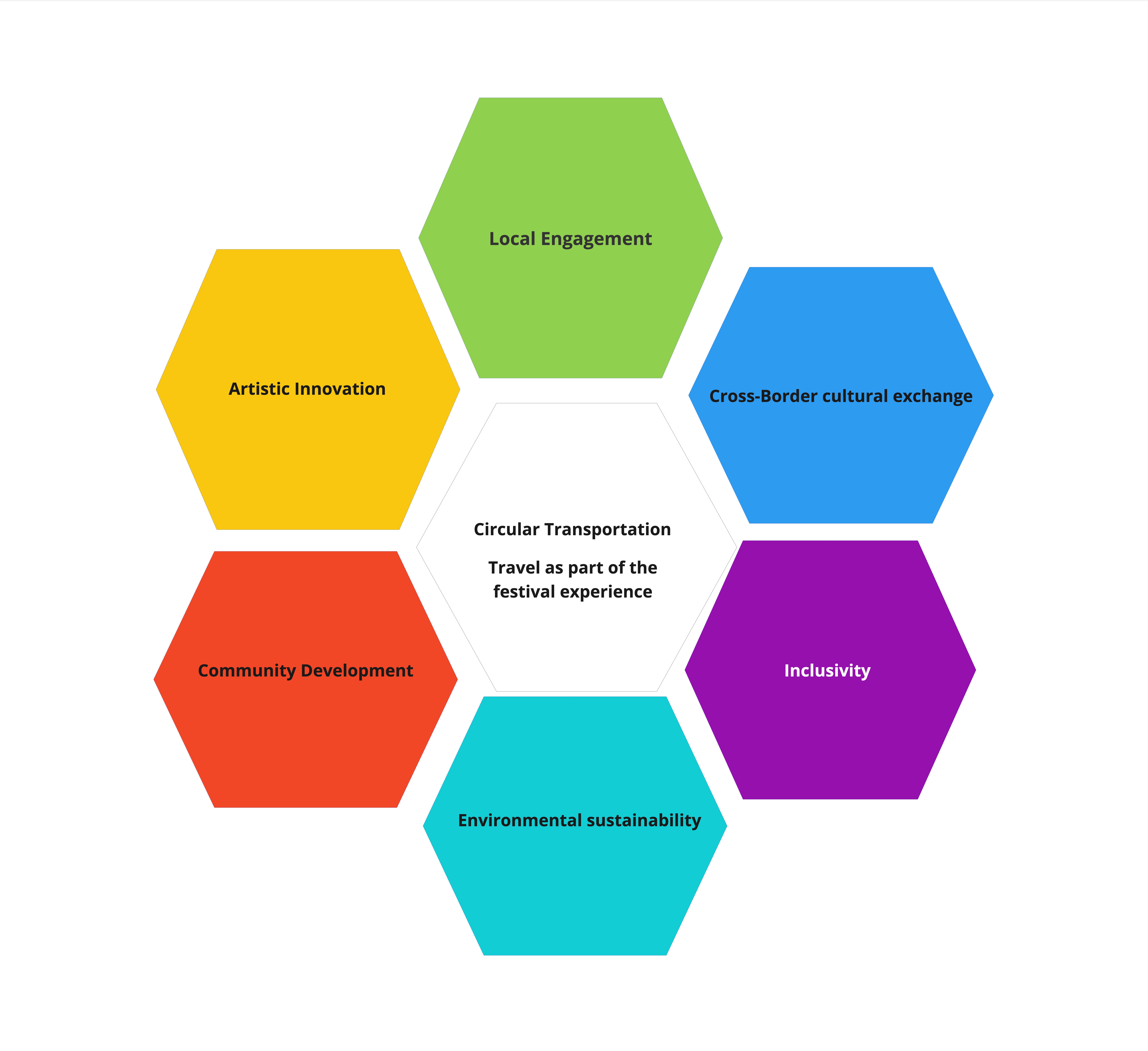
We propose a circular network of festivals that collaborate to create regenerative travel routes—reducing emissions, supporting local communities, and transforming travel into a co-created cultural movement. Instead of just getting to the festival, travelers become co-creators of the experience, forming a nomadic festival-on-the-move.
For example: along the way, they record music, perform, engage in local sustainability efforts, and build community—all while traveling through stunning Arctic landscapes using low-impact transportation.
We named this concept 'Giella Loop'—inspired by the Sami word for a ”kastögla” that forms a lasso. This metaphor reflects the way we aim to gather everyone in circular motions, connecting festivals, artists, and communities in a shared movement. Just as a lasso pulls things together in a tight, unified loop, 'Giella Loop' envisions a collaborative, regenerative travel network that connects people and places in an ever-evolving cycle.
Why does collaboration matter? Why not just focus on improving transport at each festival individually? Because regeneration happens in ecosystems, not in isolation.
By working together we can:
Reduce emissions at scale – If festivals align their travel routes, shared transport solutions become more viable and impactful, rather than scattered, one-off initiatives.
Strengthen cultural connections – Collaboration fosters cross-festival, even cross border storytelling, artistic exchanges, and shared programming. Imagine artists and festival-goers contributing to a traveling cultural project, weaving together the identities of multiple festivals.
Create better infrastructure – No single festival can establish long-term sustainable transport infrastructure alone. But a network can push for better public transport options, shared travel hubs, and policy changes that benefit the whole region.
Share resources & funding – Joint initiatives can attract stronger funding opportunities from cultural and environmental grants, making regenerative travel solutions more financially feasible.
Support local communities year-round – A networked approach ensures that regenerative initiatives don’t just benefit festivals but also leave a positive footprint in the villages, towns, and rural areas in between.
Trademark
Additionally, the Giella Loop could become a trademarked label, signaling a festival’s commitment to regenerative transportation. This instantly recognizable certification would allow festival-goers to easily identify events offering accessible, low-impact travel options, encouraging them to consider these options early in their planning. Over time, this shift can change norms around how people travel to festivals.
Conclusion
Rather than a fixed plan, this model is a flexible and adaptive strategy that responds to local conditions, traveler needs, and festival dynamics. It prioritizes active participation, where festival-goers contribute to the experience rather than simply being passengers.
This approach goes beyond just reducing environmental impact—it redefines travel as an integral part of the festival itself. By embedding regenerative principles into transportation, we create a system that not only minimizes harm but also brings lasting value to the regions, communities, and cultural networks involved.
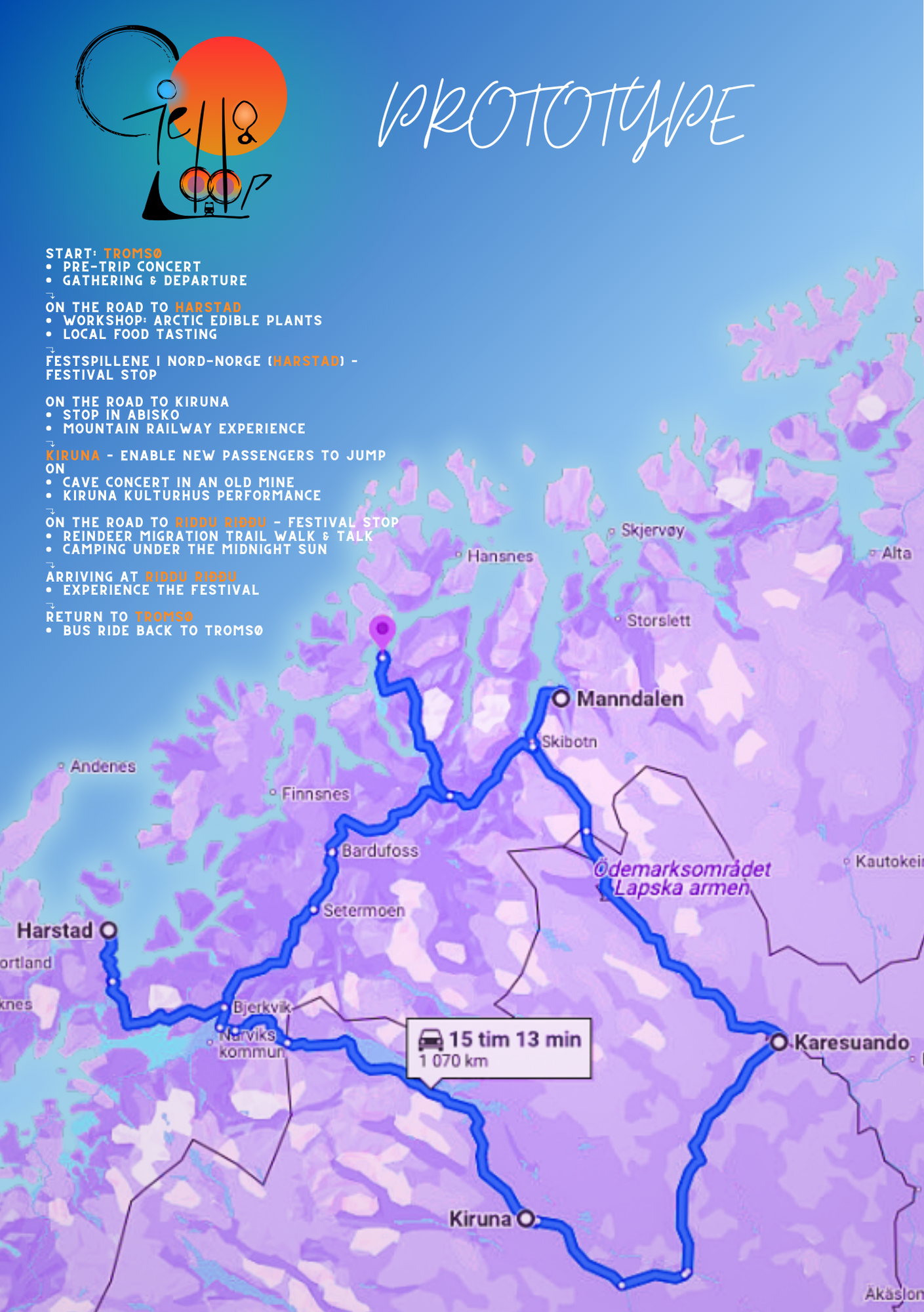
How to implement Giella Loop
We envision Giella Loop as a regenerative concept but nonetheless a functional reality.
Starting without a large organization and funding requires an organic process. We need to find out who our stakeholders actually are and then lasso them in. In order to be able to apply for funding for a larger venture, we also would like to get to know our stakeholders and their experiences and needs a little more.
Let's start by reaching out to festival organizers in our focus area! Without obligations on their part, start a network, why not as simple as via social media. The aim is to gather, inspire and from the start create opportunities for micro collaborations and coordination. Along the way, we learn and develop together.
For this we need to provide a "living toolbox", in addition to a generous and transparent sharing of good and less good experiences, connected to dealing with festival travel from organizers context.
Our role is still not to lose the helicopter perspective! To continue collecting material both from the network and external monitoring. Then analyze, compile and share, in a similar loop method that we designed our concept through. This ongoing work will result in a library for knowledge exchange and progress, as well as an improved toolbox.
A realistic timetable needs to be established and include application dates for possible financing of feasibility studies, also trials on a local scale. A feasibility study can investigate and map which actors in transport and travel industry that are currently active, both within the focus area and adjacent ones. Also identify which gaps and obstacles that exist and need to be filled. It seems reasonable to refine the concept, design a more detailed project plan and seek funding after a festival peak season.
Through the network that is being built and improved organically, festival organizers will be able to influence and collaborate broadly with travel actors. At the same time, the conditions for developing Giella Loop into a certification and a brand with certain values are being built and strengthened. In the long run, this is also the key to communicate with small and large actors who, locally and also in a larger perspective, contribute to our vision of an expanded festival experience. Last but not least, communicate with festival travelers and helping them make best possible choices.
On the way to realize our Giella Loop vision, there are different sub-elements whose core is about communication, transparency, awareness of and sharing new mindsets and a broader view of time perception, profit and growth.
Working process and method
In Week 1, the team reviewed the Barents Spektakel festival website and used Kanban, ScanCards, and Scoop Wheelto develop a pre-project. The group, initially seven members, reduced to five but maintained strong collaboration. Week 2 focused on defining the project scope, selecting transport accessibility in the northern region as the key issue. A prototype was developed in Week 3, and the project was named Giella Loop, symbolizing movement and Arctic beauty. The team presented their idea to students and the festival team in Kirkenes, receiving mixed feedback that helped refine their approach. Conducting interviews with festival directors confirmed the necessity of a transport loop and the importance of creating a cultural network. In Week 4, efforts centered on developing a website and visualizing ideasfor a compelling final presentation. Week 5 likely included the final presentation in Kirkenes, engaging with stakeholders and festival organizers.
Team Arcticnauterna

Johánas Nutti Lampa
I am an artist and go by the name NTÏV. I create spaces for creativity to flow, connections to intertwine and magic to be explored.

Elvira Runerheim
As a cultural producer, I strive to create space for the immeasurable, recognizing its inherent value in shaping our shared experience. My work is driven by a passion for making art accessible to all, fostering inclusivity, and challenging the centralization of art and culture.

Maria Podgornova
Theatre, all types of events. Art management, international projects. Creating a cultural environment and connections between cultural figures to support and promote the culture of the northern regions.

Yanina Casanova
I work community based with themes of human rights, decolonization and reconstruction through joy and creativity, towards social change. I want to make space for minorities and subcultures to express through art.

Nina Tenskog
Visual Arts & Cultural History. Curating & producing exhibitions + content. My vision of remote culture festivals is to transform challenges around geographical location into unique experiences and genuine relationships that last.